Who do you trust with a rug that took someone a year to knot by hand? That's the real question behind an oriental rug cleaning search, and it's a fair one. A lot of the companies that come up for "carpet cleaner near me" in Cypress will run the same wand over a Persian rug that they ran over the hallway carpet. Some of those rugs come out fine. Some come out with bleeding reds and a fringe that looks chewed.
Safe-Dry has cleaned oriental and hand-knotted rugs in northwest Harris County homes for over 30 years, and our process was built around the same idea that runs through everything we do: use as little water as possible, use no soap, and let carbonation do the lifting. On a wool rug with vegetable dyes, that's the difference between a clean rug and a ruined one.
We clean in your home, on your floor, with you in the room, and the rug is done the same afternoon. It never leaves your sight. If we ever think a rug truly needs a full immersion wash, we'll point you to a specialist, because immersion washing is a different trade and we won't pretend otherwise. It comes up maybe twice a year.
What makes an oriental rug different
A wall-to-wall carpet is one material, one dye process, one backing. An oriental rug might be wool pile on a cotton foundation with a silk highlight and a dozen dyes that were each set differently. The fringe is usually the foundation warp threads themselves, so damage there is structural. The pile density can be several times that of carpet, so a wet cleaning that soaks it holds water for days.
That's why our first step on any hand-knotted rug is longer than on anything else we clean.
How we clean a fine rug
Step 1. In-home assessment
We identify the fiber: wool, silk, cotton, jute, nylon, olefin, or a blend. We look at the weave, the age, and the condition of the fringe and edges. Then we do a dye test in an inconspicuous corner. If any color moves, we adjust the plan or, in rare cases, tell you the rug needs a specialist. You'll know the plan and the price before we start.
Step 2. Pre-treatment of soil and spots
The traffic path and any specific spots get a soap-free conditioner that loosens the oily film holding the dirt. Rugs near a dining table or an entry off Telge Rd pick up a lot of tracked-in clay soil and food, and pre-treatment is what makes the main pass effective on that.
Step 3. Carbonated, chemical-free clean
The carbonated solution goes on with a light hand. The bubbles push into the dense pile and lift the soil off the fiber without saturating the foundation. No detergents, no sticky residue that would attract the next round of dirt. This step is what keeps a wool rug soft and a silk rug from going stiff.
Step 4. Extraction and rinse
The loosened soil and the solution come out under vacuum. We use so little water that the cotton foundation stays essentially dry, which is the whole reason the rug can be back in use in about an hour.
Step 5. Detail work
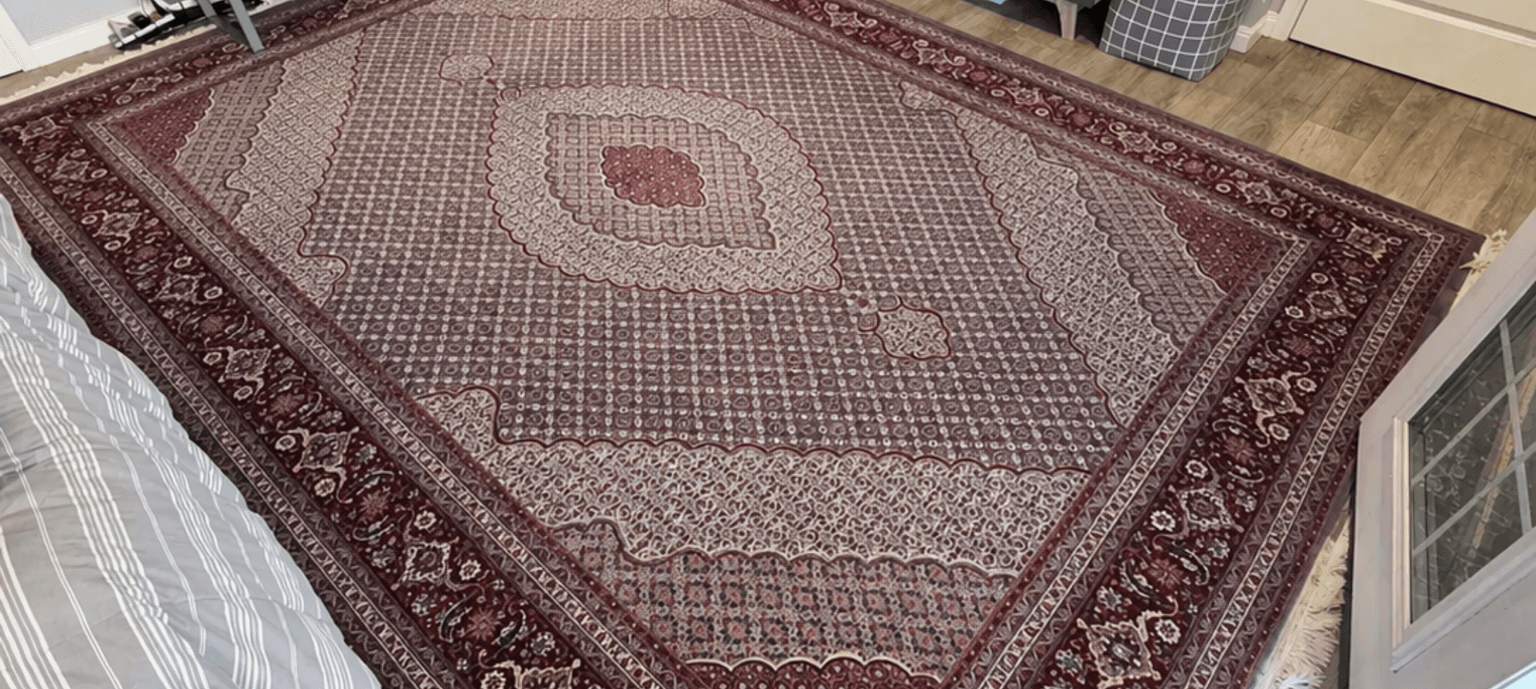
Fringe gets combed and cleaned separately. Pet spots and odors get targeted treatment, and stubborn areas get a second look. This is slow work on purpose. A rug with a detailed medallion deserves more than a quick pass.
Step 6. Drying and review
We groom the pile in the direction of the nap and walk the result with you. Most rugs are dry an hour later. We'll also talk about rotation, sun exposure, and how often to have it done.
Rugs we're set up to clean
- Persian and other hand-knotted wool rugs
- Silk and silk-blend rugs
- Cotton flatweaves and dhurries
- Jute and natural fiber rugs
- Machine-made wool, nylon, and olefin rugs
- Synthetic rugs of every construction
Something I'll say that a rug dealer won't: about half the "oriental rugs" we get called about in Cypress are machine-made, and that's fine. They look good, they wear well, and they don't need the fine-rug price. If yours has a stitched-on fringe and a perfectly regular pattern on the back, it's machine-made, and our area rug cleaning page covers the same in-home service at a lower rate. Hand-knotted rugs show individual knots on the back and the fringe runs straight out of the foundation. The $25 rug coupon works on either.
Fringe, edges, and the things that go wrong
Most damage we see on oriental rugs in Cypress homes didn't come from dirt. It came from a bad cleaning. Fringe that was scrubbed with a stiff brush and now looks frayed. A red border that bled into a cream field because nobody tested the dye. A cotton foundation that got soaked, took three days to dry, and now has a faint mildew smell you can't place. Once you've seen enough of those, you clean carefully.
Moths, and the rug under the guest bed
The other common problem is moth damage on wool rugs stored in a closet or left under a piece of furniture for years. Moths like undisturbed, slightly dirty wool. A rug that gets cleaned and rotated on a schedule rarely has the problem. A rug that has been under the guest-room bed since the move from the old house often does. If we find larvae or bare patches at the assessment, we'll show you and go over your options.
When it's time
Rug dealers say every 12 to 18 months, and for a rug in a busy room that's about right. Some signs you're overdue: the colors look flat, the pile feels gritty when you run a hand against the nap, there's a pale patch where a chair used to sit, or the rug smells musty after a humid week. That musty smell is a warning. Gulf Coast humidity plus a rug full of organic soil is how mildew gets started in a cotton foundation, and that's hard to reverse.
Frequently asked questions
Will the reds bleed?
Not if the dye test says they're stable, and we don't proceed until it does. The test takes a couple of minutes in a corner nobody looks at. If a color moves, we change the plan or send you to a specialist.
How long does oriental rug cleaning take in Cypress?
Usually 30 to 60 minutes of work per rug, depending on size and condition, and about an hour to dry.
Do I need to keep the dog off it afterward?
Only until it's dry. The solution has no soap and no fragrance, and nothing is left in the fiber.
It's in the formal living room and nobody goes in there. Still yearly?
Less often. A rug that sees little traffic can go longer than the 12-to-18-month rule, though it should still be rotated and vacuumed, and checked for moths if it's wool.
The cat got to the corner years ago. Is that fixable?
Old pet urine on wool is the hardest case we take on. The odor usually goes. The stain may only lighten, and you'll get a straight estimate of how much before we begin.
How do I get someone out to look at it?
Call 281-746-6055 or request a quote online. We're open 24/7 and serve all of Cypress and northwest Harris County.
The next step
Give 281-746-6055 a call, or reserve a time on your own, and bring your questions. We like talking about rugs.